Alluvial Tin Processing Plant for Placer Tin Recovery
Why Alluvial Tin Ore is Easier to Process?
An alluvial tin processing plant takes advantage of the natural “pre-concentration” of placer deposits. First of all, cassiterite (SnO₂) has a high specific gravity (6.8–7.1 g/cm³), making it ideal for gravity separation. Furthermore, it is hard and chemically stable, resisting degradation during transport. Therefore, unlike hard rock tin, an alluvial tin processing plant requires no crushing or grinding — only washing, screening, and gravity separation, resulting in much lower capital and operating costs.
2000 TPD Alluvial tin processing plant flow sheet
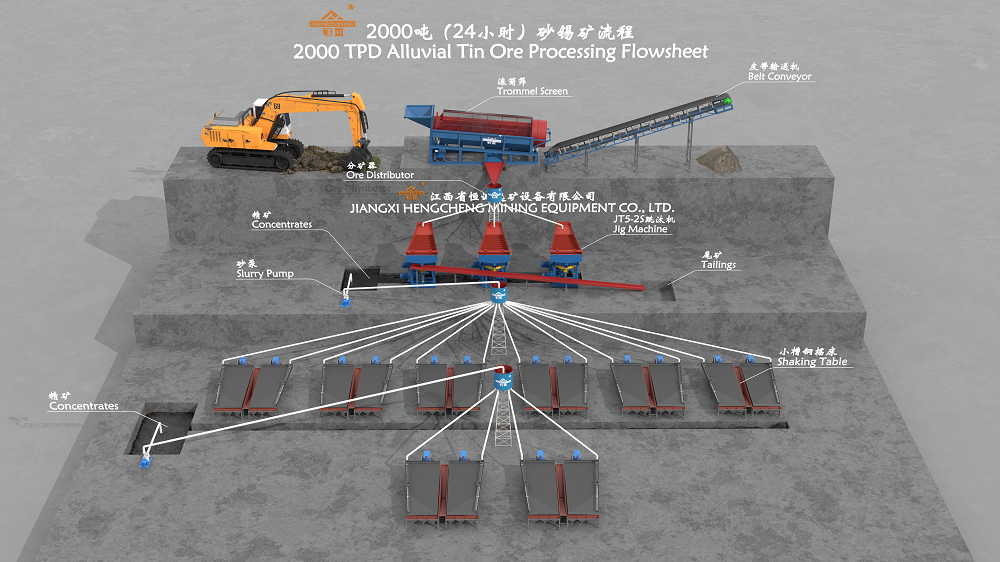
This 3D flow sheet illustrates a complete 2000 TPD (24-hour operation) alluvial tin processing plant. The core logic is “Wash & Screen → Jig Roughing → Shaking Table Cleaning.”
- Feeding & Hopper:An excavator feeds raw ore into trommel screen.
- Washing & Screening:Raw ore enters a Trommel Screen. High-pressure water washes away clay, while the rotating drum screens out large gravel and debris. This step is critical — if clay is not thoroughly washed, tin particles will be wrapped and lost in the tailings.
- Jig Roughing(Coarse Tin Recovery): The undersize slurry is fed into Jig Machines. Jigs use pulsating water to stratify heavy minerals, recovering coarse tin particles (typically a few millimeters) efficiently at a high capacity. This is the “workhorse” of alluvial tin recovery.
- Slurry Pumping & Distribution: The jig concentrate is pumped by a Slurry Pump to a distributor, which evenly feeds multiple Shaking Tables.
- Shaking Table Cleaning(Fine Tin Upgrading): Shaking tables provide the final precision separation. Through bed oscillation and water flow, tin concentrate, middlings, and tailings are separated into distinct bands. After multi-stage cleaning, tin concentrate grade can exceed 60%, meeting smelter requirements. Middlings are returned for re-processing to maximize recovery.
Alluvial tin processing plant Main Equipment
Trommel Screen
For washing, clay dispersion, and size classification.

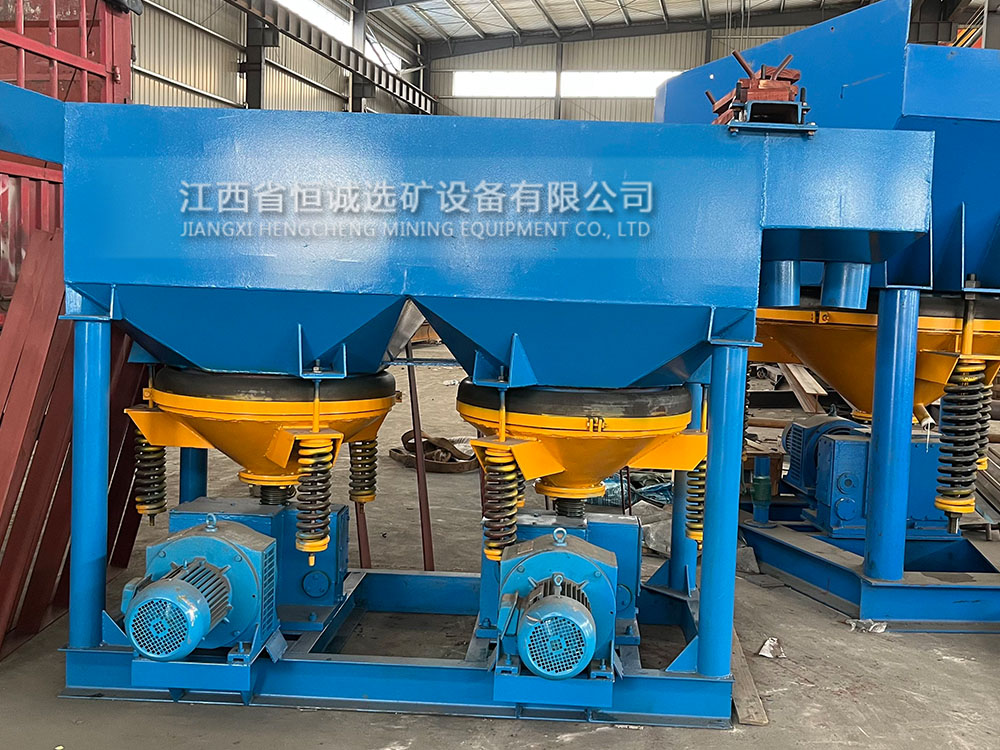
Jig Machine
For high-capacity roughing of coarse tin particles.
Shaking Table
For final cleaning and high-grade concentrate production.

Why Jig + Shaking Table? A Smart Combination
This is a classic and highly cost-effective combination for alluvial tin:
Jig Machine: Handles large volumes and a wide particle size range (coarse tin), but has limited precision.
Shaking Table: Provides high-precision upgrading for fine tin, but has a lower capacity per unit.
Therefore, using jigs for bulk roughing and shaking tables for final cleaning balances capacity, recovery, and concentrate grade, while keeping equipment investment and energy consumption optimized.
Frequently Asked Questions About Alluvial Tin Processing
Q: What is the typical capacity range for an alluvial tin plant?
A: We design plants from 10 TPH to 200+ TPH, based on your deposit size and production targets.
Q: How do I control the final tin concentrate grade?
A: The shaking table is the key. By adjusting the table slope, stroke, and wash water, you can control the separation and achieve a concentrate grade of 60% Sn or higher.
Q: What if my alluvial ore has high clay content?
A: We recommend adding a Rotary Scrubber before the trommel screen to break down tough clay, ensuring complete liberation of tin particles.